Block Walls and Foundations Built Level From the Start
Concrete block wall and foundation construction in Brandon for residential and commercial properties requiring structural masonry laid to specification
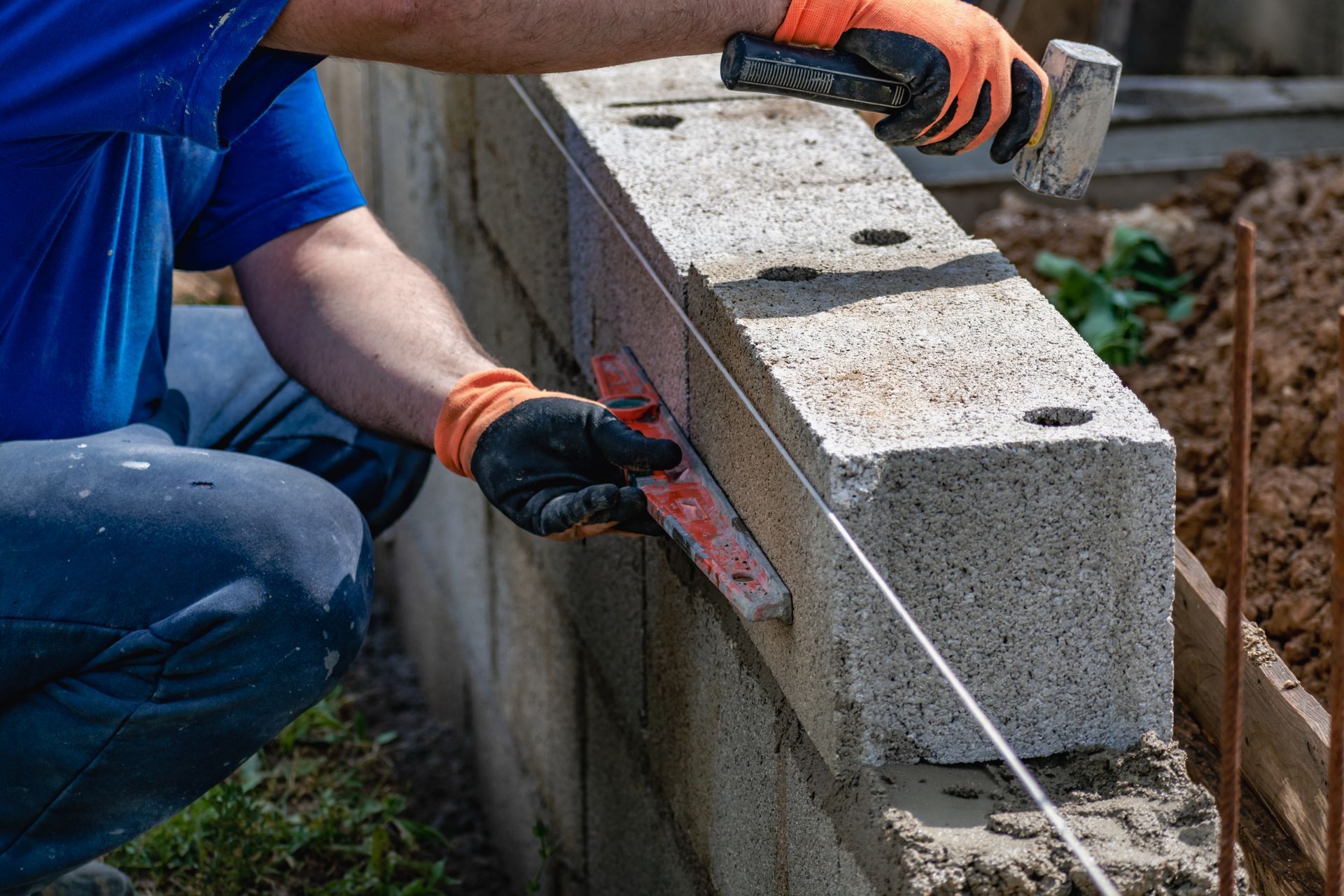
Concrete block construction that goes out of level on the first course compounds through every course above it. By the time a wall reaches full height, a small deviation at the base has created a structure that cannot be corrected without tearing down and starting over. The construction method John Douglas Masonry uses addresses this directly: each course is checked for level before the next is laid, blocks are set in running bond with consistent joint thickness, and mortar is applied with proper coverage across the full bed and head joints—not spot-bedded, which reduces the wall's effective strength. This is how block work is done correctly, and it is the standard applied to every project John Douglas Masonry takes on in Brandon, whether residential foundation work or commercial block wall construction.
Concrete block foundations and walls on properties in the Ridgeland and Brandon areas often involve structures where vertical and horizontal alignment affect more than appearance—they affect how load transfers through the wall and how well the structure performs when adjacent soil exerts lateral pressure. Running bond, the pattern where each block spans the joint of the course below it, distributes load across the assembly rather than concentrating it at a single vertical seam. John Douglas Masonry applies this standard on every course, verified with a level before the mortar sets, which is the checkpoint that separates properly built block from block that looks adequate until it is under load.
To discuss your block wall or foundation project scope, call (601) 316-0980 to arrange a consultation or submit project details for an initial quote.
Block wall construction involves decisions at every course: mortar consistency, plumb verification on corners, and joint tooling before the mortar reaches full set. Joints that are not tooled while the mortar is at the correct green stage do not compress properly, which leaves a surface that is more permeable to water than a correctly tooled joint. John Douglas Masonry checks plumb at corners and at intermediate points across long wall runs, because a wall that is plumb at the corners but bowed in the middle has a structural weakness at the point of maximum deviation.
When block construction is finished correctly, the visible result is a wall with consistent joint width, uniform color distribution, and no visible bow or lean across the face. Tooled joints shed water rather than collect it, and the wall's corners are plumb to the degree that finish materials—whether stucco, flashing, or framing connections—can be applied without shimming or compensating for irregularities. Customers working with John Douglas Masonry have regularly been charged below the original estimate, which is a product of accurate scoping at the outset rather than additions and overages as work progresses.
Block wall projects that involve structural connections to existing foundations or that exceed certain wall heights are subject to permit requirements in Brandon and surrounding jurisdictions. Understanding those thresholds before construction begins avoids delays at inspection. Project review at John Douglas Masonry includes identifying whether permit applications are required for the specific scope of work.
Questions About Concrete Block Wall Construction
Block construction questions often center on how the work is sequenced and what makes one installation more durable than another. The answers below address the technical decisions that determine long-term performance, particularly for the residential and commercial properties found across the Brandon area.
What is running bond and why is it used in concrete block construction?
Running bond means each block is offset by half a unit length from the blocks in the course above and below it, so the vertical joints never align continuously from top to bottom. That offset distributes load laterally across the wall rather than creating a continuous weak plane, which significantly improves the wall's resistance to both vertical and lateral forces.
How is mortar consistency verified during block installation?
Mortar that is too dry does not bond to the block face and will crumble at the joint over time. Mortar that is too wet slumps and cannot hold the block in position while it sets. The test is workability and adhesion: properly mixed mortar holds its shape when tooled and sticks to a vertical surface without sliding. John Douglas Masonry monitors mortar mix throughout the workday as conditions change, not just at the initial batch.
When should concrete block be used instead of poured concrete for a foundation wall?
Block is preferred when the construction sequence benefits from staged installation, when the wall height makes formwork for poured concrete impractical, or when openings need to be incorporated at specific courses. Poured concrete walls have monolithic strength advantages in some conditions, but block walls built with proper mortar, reinforcement, and grouting meet structural requirements for most residential and light commercial foundations in Brandon.
How do you verify a block wall is plumb across a long run?
Corner plumb is checked with a spirit level on both faces of the corner block at every course. For long wall runs between corners, a mason's line is set at the face of the block and pulled taut to detect any bow in the intermediate blocks. Deviation is corrected at the course where it appears, not compensated for in subsequent courses.
What is the difference between face-shell bedding and full-bedding mortar application in block work?
Face-shell bedding applies mortar only to the outer shells of the block, which is adequate for non-structural walls. Full bedding applies mortar across the entire top face including the webs, which increases compressive strength and is required for structural block walls and foundation applications. The specification for your project determines which method is appropriate.
John Douglas Masonry also performs concrete block construction in Pearl, Madison, Flowood, Ridgeland, and Jackson. To review your block wall or foundation project and receive a quote, call (601) 316-0980.